

Publication details
Sources
Original post
Date
Tags
US climate policy just became much more certain
Author: Mike Harut
On 4 July 2025, US President Trump signed the sprawling ‘One Big Beautiful Bill’ (OBBB) into law. Among many things, the law amended the Biden-era Inflation Reduction Act (IRA) incentives and credits for clean energy and decarbonisation spending.
So what’s the impact?
Much more certainty: Most importantly, the uncertainty that plagued the sector since the prospect of a Republican ‘red sweep’, which came into focus 18 months ago, is essentially over.
Of course, the Trump administration remains unpredictable – in fact, an Executive Order on enforcing the tightened OBBB rules for renewables developers followed quickly after the bill was signed. However, our view is that further legislative changes under this administration are unlikely.
Investors and companies don’t like regulatory uncertainty. Now that’s cleared, we expect more investment and spending to happen.
Lots of policy support remains: As we expected, many incentives within the IRA have been retained, including those for nuclear energy, energy storage and US-based manufacturing of clean energy equipment like batteries and renewables.
This is because they support stable, resilient electricity grids – which the US needs to fulfil the Administration’s ‘energy dominance’ and reshoring agenda – and because they support onshore US jobs.
Even renewable energy investment and production tax credits have been spared the worst-case scenario, and for large developers like NextEra Energy who have long prepared for potential changes, we don’t predict a significant impact.
The components most impacted include offshore wind – the President’s pet hate – and residential solar and electric vehicles, which have both been criticised for effectively providing tax breaks to wealthier Americans.
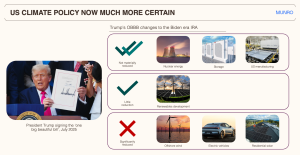
Source: Munro estimates. This is not an exhaustive list.
What does it mean for investing in the transition?
For the last 18 months or so, we have focused on the parts of the US decarbonisation opportunity that are bipartisan like carbon-free nuclear energy and the electrical grid. This has proven to be successful, with companies such as nuclear energy generator Constellation Energy, power, wind and electrification company GE Vernova and electrical infrastructure services company Quanta Services among the top performers.
We continue to see opportunities here and don’t anticipate wholesale portfolio changes.
But on the ground, the clean energy transition continues apace. In fact, over 90% of new electricity generation in the US is set to be renewables and battery storage this year¹. The relative cost and development time versus new gas or nuclear energy is compelling².
With this in mind, we have begun to revisit renewables developers and equipment makers and other opportunities such as energy storage for investments.
¹ Source: U.S. Energy Information Administration. (2025). U.S. electricity generation capacity additions in 2025. https://www.eia.gov/electricity/
² See, for example, slides 6 and 7 from NextEra Energy’s recent presentation here.
Written by Mike Harut
Responsible Investment Manager
IMPORTANT INFORMATION: The information discussed in this article is for general information purposes only and is not financial advice. The views held by Munro Partners are current as at 14 July 2025 and are subject to change. This information has been prepared without taking account of the objectives, financial situation or needs of individuals. Before making any investment decision, investors should consult a professional adviser. This information has been prepared by Munro Partners, a corporate authorised representative of Munro Asset Management Limited (ACN 163 522 254) an Australian Financial Service licence holder AFSL 480509. Information about the Munro funds is available at munropartners.com.au. This document is issued on 16 July 2025.